App links
Built for the 2026/27 UK tax year
Know exactly what lands in the UK bank account before you accept the offer.
Take Home Pay UK helps international workers, relocators, and foreign HR managers estimate what an employee actually keeps from a UK salary, bonus, or dividend.
Quick facts
- Pricing
- Free to download with all four calculators, and a one-time Premium purchase that removes ads and permanently unlocks the Pay Rise Planner.
- Platforms
- iPhone, iPad
- Best for
- Relocators, cross-border employees, contractors, and HR teams modeling UK offers and packages.
- Availability
- App Store ID 6761020850
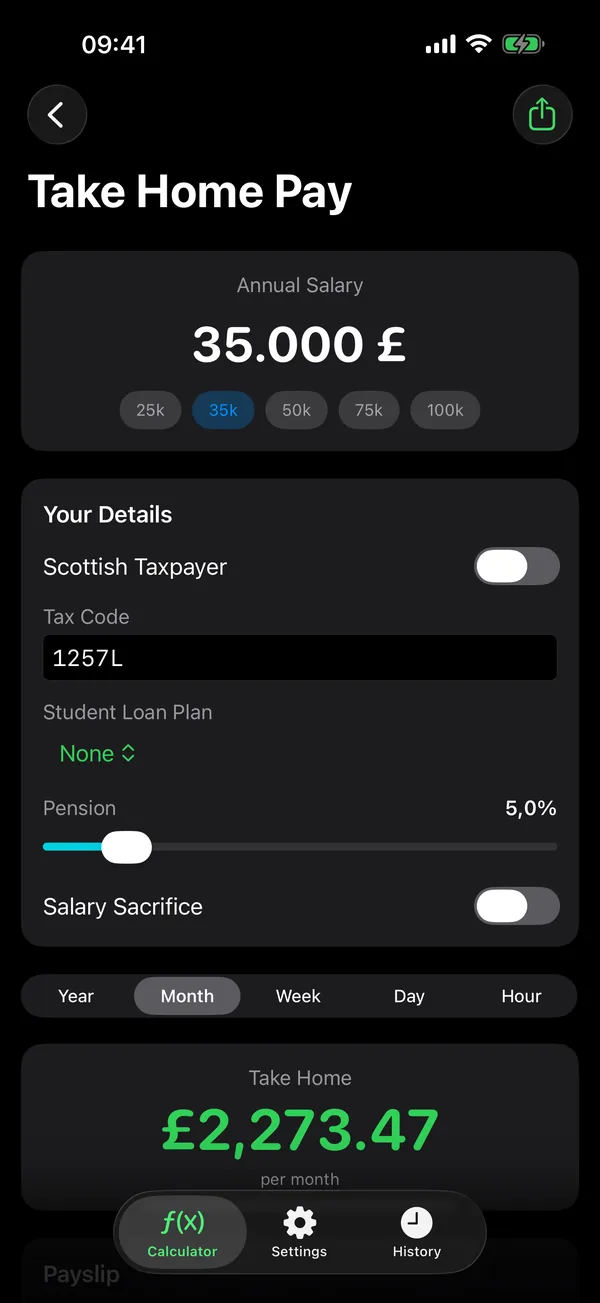
Enter an annual figure and instantly see take-home across yearly, monthly, weekly, daily, and hourly views, with full 2026/27 support, Scottish rates, and every common tax code built in.
Launch kit
Take Home Pay UK 2026/27 links, release notes, and shipping details
This section keeps the practical launch information in one place so the page can work as a product landing page, support hub, and handoff point for future catalog growth.
Launch details
- Pricing
- Free to download with all four calculators, and a one-time Premium purchase that removes ads and permanently unlocks the Pay Rise Planner.
- Platforms
- iPhone, iPad
- Current version
- 1.1
- Last updated
- May 1, 2026
- Category
- Tax and income tool
- App Store ID
- 6761020850
Latest release
Updated for the 2026/27 UK tax year
This release refreshes Income Tax, National Insurance, Scottish rates, and student loan thresholds for 2026/27, with the Employer NI reliefs and Pay Rise Planner refined.
What it helps with
What Take Home Pay UK 2026/27 helps you do
This page is designed to explain the app clearly, show how the workflow fits together, and help the right user decide quickly whether the product is a fit.
Enter an annual figure and instantly see take-home across yearly, monthly, weekly, daily, and hourly views, with full 2026/27 support, Scottish rates, and every common tax code built in.
Key signals
2026/27 UK tax year
4 Calculators built in
Scot Scottish rates
0 Data sent to servers
- Full 2026/27 tax-year support with Scottish rates
- Every common tax code, from 1257L to K and S-prefix
- Calculations run locally, no account required
- Based on published HMRC and Revenue Scotland figures
Product screens
Take Home Pay UK 2026/27 in use
Step by step
How Take Home Pay UK 2026/27 fits into the workflow
Enter the pay figure
Start with an annual salary, bonus, or dividend and pick the right tax code and region.
See take-home every way
Read the result across yearly, monthly, weekly, daily, and hourly views in one place.
Model the decision
Compare offers, test a pay rise, or check whether a higher salary trips a tax trap before you commit.
Feature detail
Why teams choose Take Home Pay UK 2026/27
The core calculator
From gross salary to real UK take-home
The main calculator covers the full deduction stack for 2026/27, so the number you see is the one that actually reaches the account.
- Income Tax, National Insurance Class 1, and pension contributions
- Student loan plans 1, 2, 4, 5, and Postgraduate, with Scottish rates
- Salary sacrifice and tax code support including K, NT, S-prefix, and M1/W1
Beyond base pay
Bonuses, dividends, and the employer side
Three further calculators cover the parts of UK pay that catch people out, from the 60 percent tax trap to secondary NICs.
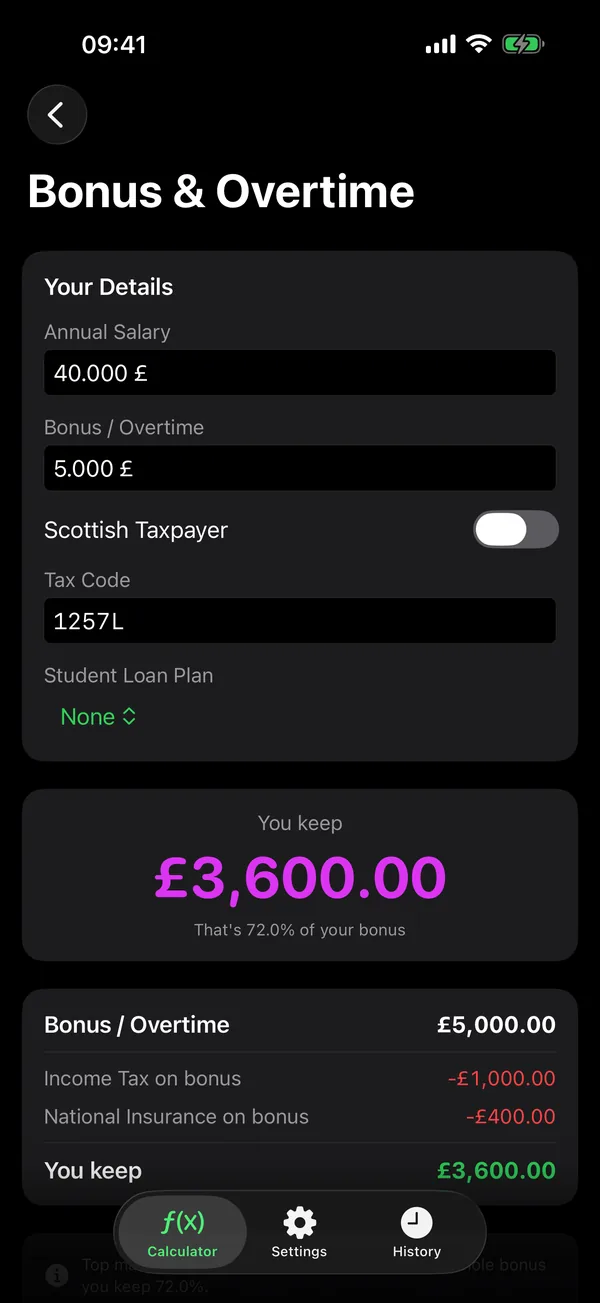
- Bonus and Overtime at the real marginal rate, including the GBP 100k to GBP 125,140 trap
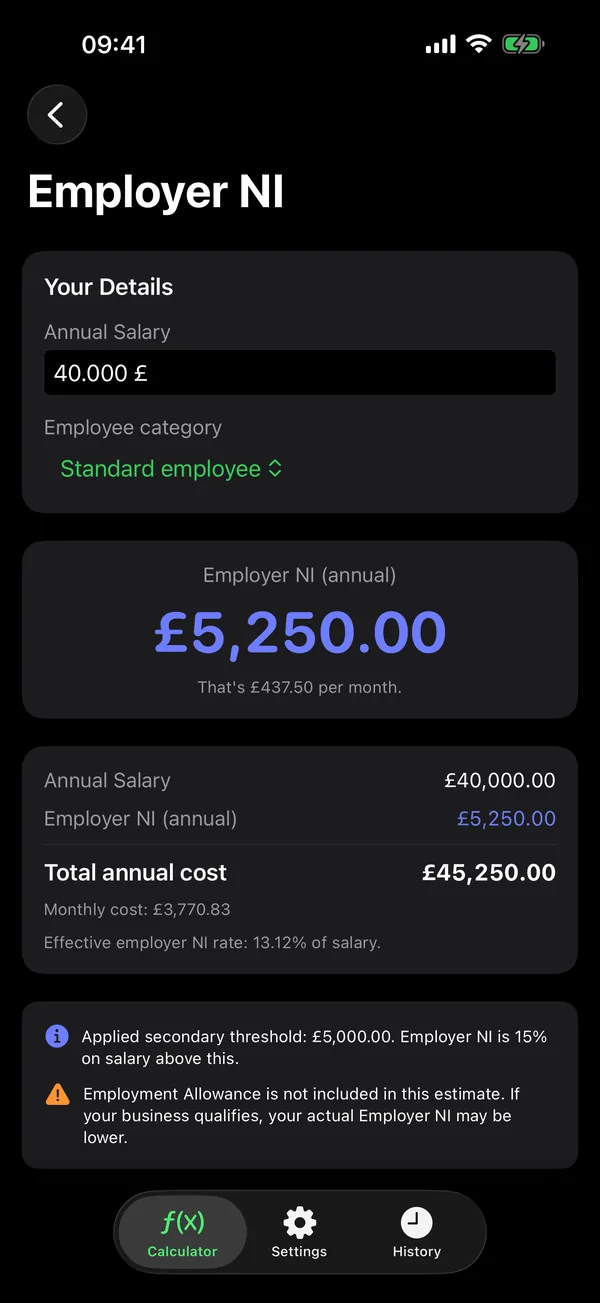
- Employer NI for 2026/27 with Under 21, Apprentice, Veteran, Freeport, and Investment Zone reliefs
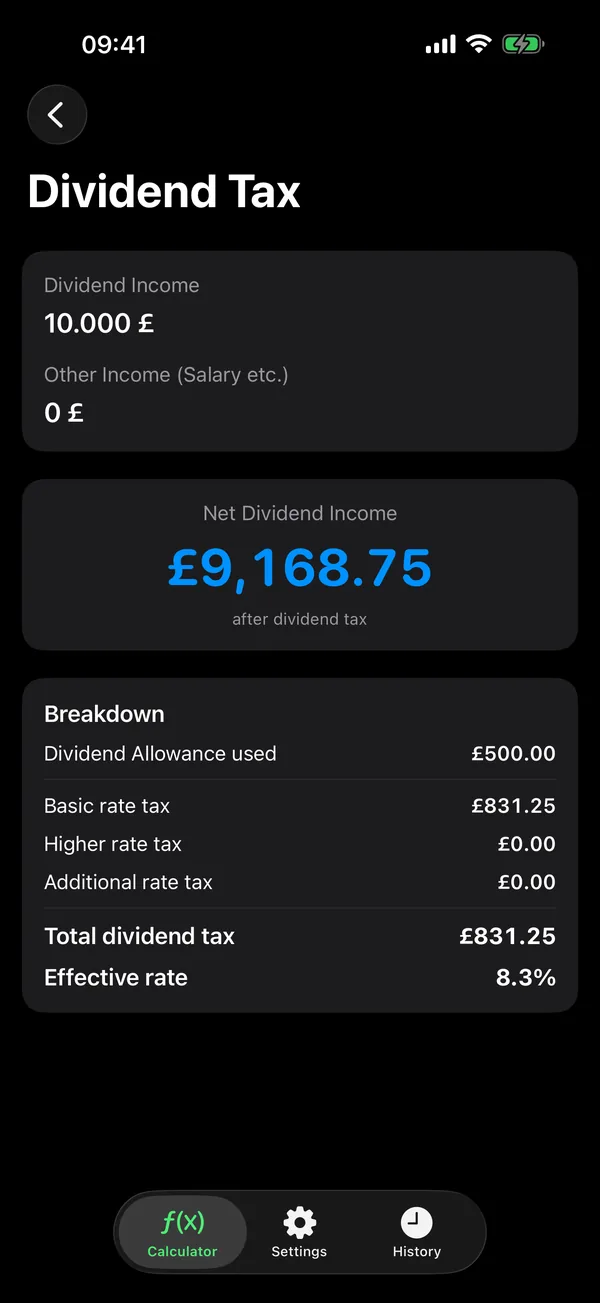
- Dividend Tax with the GBP 500 allowance layered on top of the salary band
Planning and history
See where a pay rise really lands
The Pay Rise Planner and on-device history turn a one-off check into something you can revisit and refine over time.
- Pay Rise Planner showing how much of a higher salary reaches the bank each month
- Local Calculation History to re-open and tweak past scenarios
- Premium removes ads and unlocks the planner permanently
Recent updates
What has changed recently in Take Home Pay UK 2026/27
A lightweight release history helps these app pages act like living product documents instead of frozen launch announcements.
1.1
Updated for the 2026/27 UK tax year
This release refreshes Income Tax, National Insurance, Scottish rates, and student loan thresholds for 2026/27, with the Employer NI reliefs and Pay Rise Planner refined.
Best fit
Who Take Home Pay UK 2026/27 is built for
Relocators and expats
For people modeling a London, Manchester, or Edinburgh package against a current US or EU salary before moving.
Foreign HR managers
For teams building offer letters and relocation packages who need fast, credible UK take-home figures.
Contractors and multi-job earners
For people working out a day rate from a target salary or estimating take-home on a second job with a BR or D0 code.
Questions
Questions people ask before downloading Take Home Pay UK 2026/27
Does it cover Scottish income tax?
Yes. Scottish rates are built in alongside rest-of-UK rates, so you can compare a Glasgow role against a London one.
Can it handle bonuses and dividends?
Yes. Separate Bonus and Overtime and Dividend Tax calculators show the real marginal rate, including the 60 percent trap and the dividend allowance.
Is my salary data sent anywhere?
No. Calculations run locally on your device, nothing is sent to a server, and no account is required.
Is it official HMRC advice?
No. It is an independent informational tool, not affiliated with HMRC or Revenue Scotland, and does not constitute tax advice. Confirm binding figures with a qualified adviser.
Beyond the app
Need something more tailored than Take Home Pay UK 2026/27?
If your agency or HR team needs UK take-home logic inside a broader offer-modeling, relocation, or client-facing workflow, I can build a tailored version around your exact process.
- Bespoke offer-letter and relocation modeling tools
- Employer-cost calculators for hiring and quoting
- A bridge from one estimate to a full payroll workflow
Bigger workflow
If this app opens up a bigger problem
The app may solve a concrete job immediately. If it exposes a larger operational, web, or content problem behind it, these are the closest practical routes.
Operational systems
If the workflow behind the app reveals manual steps, approval layers, tool sprawl, or operational debt, this is where it becomes a real system.
Web platforms
If this direction points toward a portal, stronger web layer, SEO surface area, or client-facing interface, this is the closest next route.
Related writing
Why 'My Accountant Handles It' Isn't a System
Accountants handle paperwork. They don't prevent operational non-compliance. That's a system problem.
Why Compliance Is System Behavior, Not Paperwork
Compliance fails not because someone ignored the law, but because behavior wasn't encoded. Paperwork proves compliance — systems create it.
Airtable, Monday, Asana — Why the Tool Doesn't Matter
Teams debate tools endlessly. The tool is almost never the problem. The process underneath, the ownership, the behavior—that's what breaks.
Related case studies
Dentelli: Acting as an Embedded Growth Partner During a Premium Clinic's Scale-Up
A multi-year embedded role spanning content, campaigns, events, reporting, and growth execution while a premium dental clinic scaled significantly in Split.
Enaviga: Building the Sales Playbook Behind a Charter-Tech Product
A progression from visual asset production into business development, sales structure, market validation, and operational content systems for a boating-tech startup.
Take Home Pay UK 2026/27
Download Take Home Pay UK 2026/27, then extend the workflow if your team needs more.
Start with the shipping app when it solves the core job. If you later need approvals, reporting, portals, or a more specialized internal workflow, that can become a custom build.