App links
Built for the new LFSS 2026 birth leave
Walk into your CPAM and employer conversations already knowing roughly what the new birth leave pays.
Congé Naissance 2026 is an indicative simulator for the new French supplementary birth leave created by LFSS 2026, helping parents estimate their allowance before the official details are finalised.
Quick facts
- Pricing
- Free to download, with a one-time €4.99 Premium that unlocks the visual leave timeline and removes ads.
- Platforms
- iPhone, iPad
- Best for
- Expecting parents in France preparing for the supplementary birth leave that starts 1 July 2026.
- Availability
- App Store ID 6761137510
It applies the available CPAM/IJSS reference method — capped daily salary, the 2026 social security ceiling, then the indicative 70% first-month and 60% second-month coefficients — so you can prepare the right questions before talking to your employer, CPAM, or a social-law professional.
Launch kit
Congé Naissance 2026 links, release notes, and shipping details
This section keeps the practical launch information in one place so the page can work as a product landing page, support hub, and handoff point for future catalog growth.
Launch details
- Pricing
- Free to download, with a one-time €4.99 Premium that unlocks the visual leave timeline and removes ads.
- Platforms
- iPhone, iPad
- Current version
- 1.1
- Last updated
- May 1, 2026
- Category
- Tax and income tool
- App Store ID
- 6761137510
Latest release
Updated 2026 parameters and timeline view
This release tracks the 2026 PMSS and CPAM/IJSS basis, refines the couple simulation and PreParE comparison, and improves the Premium Gantt timeline with clearer key dates.
What it helps with
What Congé Naissance 2026 helps you do
This page is designed to explain the app clearly, show how the workflow fits together, and help the right user decide quickly whether the product is a fit.
It applies the available CPAM/IJSS reference method — capped daily salary, the 2026 social security ceiling, then the indicative 70% first-month and 60% second-month coefficients — so you can prepare the right questions before talking to your employer, CPAM, or a social-law professional.
Key signals
1 Jul 2026 Leave start date
4 Built-in calculators
€4.99 One-time Premium
On-device Inputs stay private
- Built on the LFSS 2026 law and CPAM/IJSS reference method
- Calculator inputs and history stay on your device
- No account required to simulate
- Indicative only — not affiliated with CPAM, CAF, or French public services
Product screens
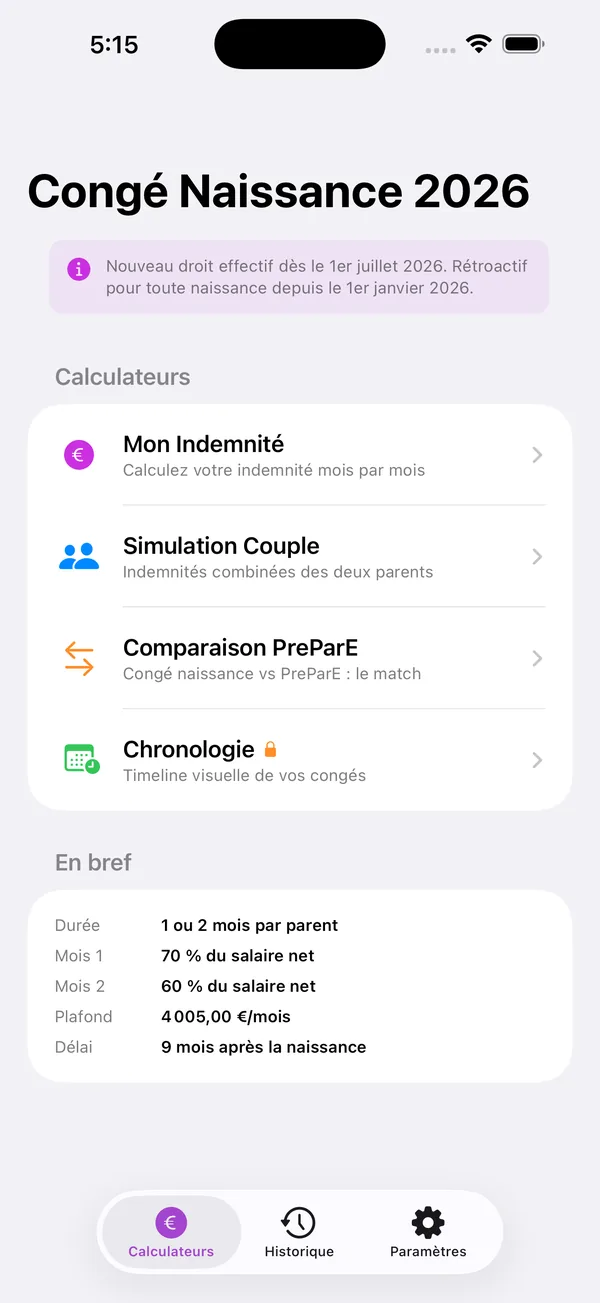
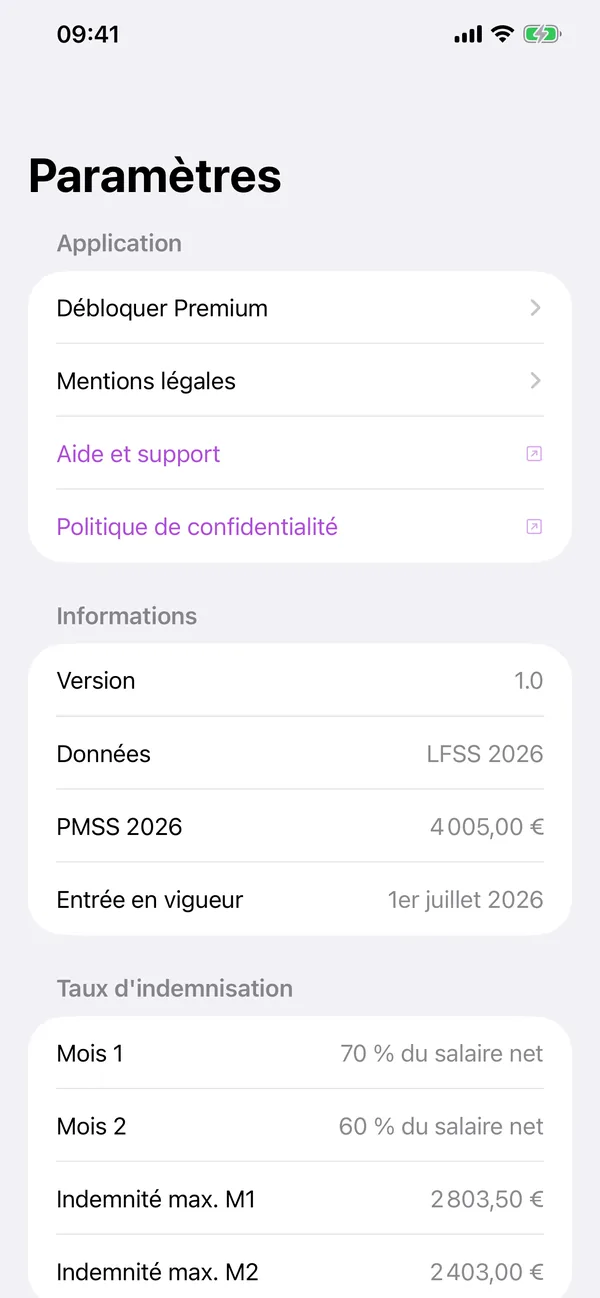
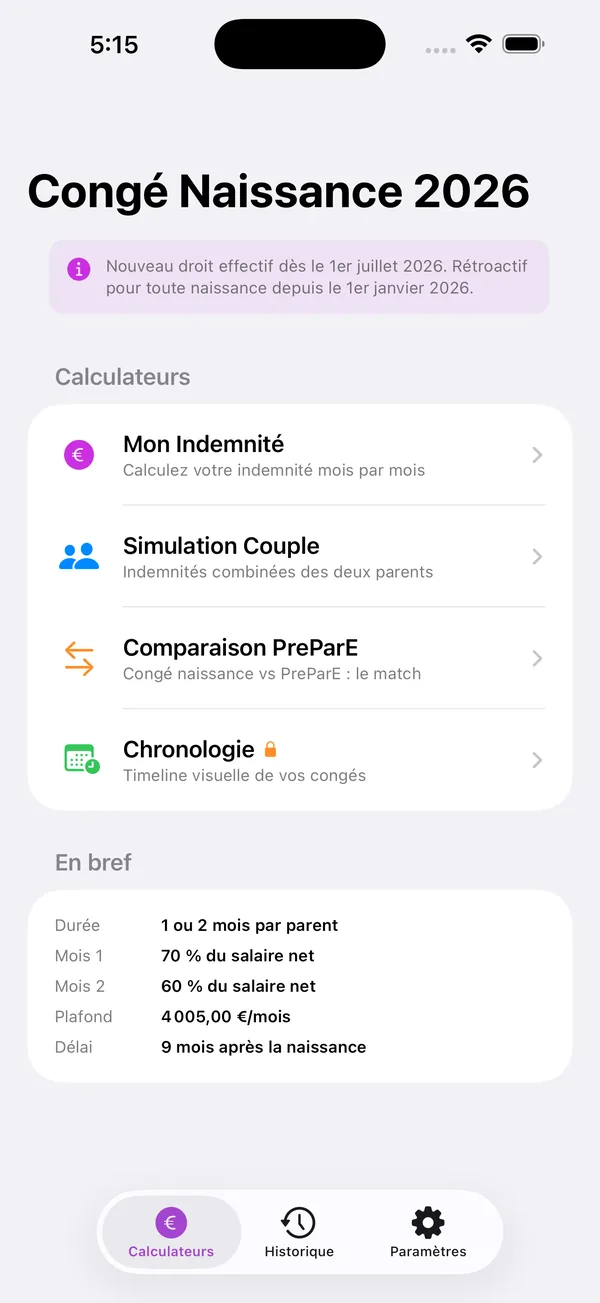
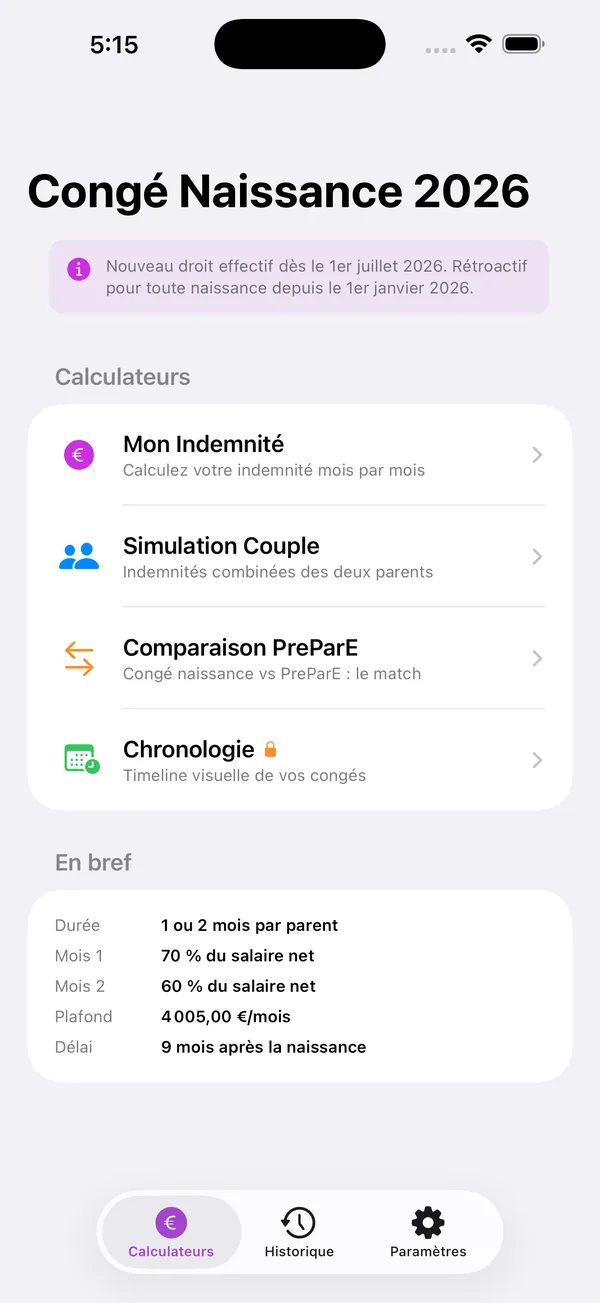
Congé Naissance 2026 in use
Step by step
How Congé Naissance 2026 fits into the workflow
Estimate your own allowance
Enter gross salary, status, and a duration of one or two months to see your month-by-month allowance.
Simulate as a couple
Add the second parent to estimate combined allowances and visualise a possible split of the leave.
Compare with PreParE and map the dates
Set the new leave beside the existing PreParE benefit, then use the Premium timeline to mark employer notice and application deadlines.
Feature detail
Why teams choose Congé Naissance 2026
Allowance estimate
Turn the new law into a number you can plan around
The headline leave is new and unfamiliar. The app converts your salary and status into an indicative allowance using the CPAM/IJSS reference method.
- Month-by-month estimate from gross salary and duration
- Status options for non-executive, executive, and public sector
- Tracks 2026 parameters including the €4,005 PMSS and indicative coefficients
Two parents, one plan
See how the leave works across a couple
Birth leave decisions are rarely made alone. The couple simulation helps both parents picture the combined allowance and a workable split.
- Estimate the combined allowances of both parents
- Visualise a possible split based on your assumptions
- Compare the new leave directly against PreParE
Premium timeline
Map every key date on a single Gantt chart
Once the numbers are clear, timing is the next worry. Premium lays out maternity, paternity, supplementary leave, and PreParE so deadlines do not slip.
- Complete visual timeline of your leave
- Important dates highlighted, including employer notice
- Extended sharing of the timeline, ad-free
Recent updates
What has changed recently in Congé Naissance 2026
A lightweight release history helps these app pages act like living product documents instead of frozen launch announcements.
1.1
Updated 2026 parameters and timeline view
This release tracks the 2026 PMSS and CPAM/IJSS basis, refines the couple simulation and PreParE comparison, and improves the Premium Gantt timeline with clearer key dates.
Best fit
Who Congé Naissance 2026 is built for
Expecting parents
For mothers and fathers who want to understand the new leave before notifying their employer.
Couples planning together
For partners deciding how to split the supplementary leave between them.
Parents weighing PreParE
For families comparing the new birth leave against the existing shared child-education benefit.
Questions
Questions people ask before downloading Congé Naissance 2026
When does the new birth leave start?
From 1 July 2026, subject to details confirmed by implementing texts. A transitional rule covers births between 1 January and 30 June 2026, with applications possible until 31 March 2027 per Health Insurance guidance.
Are the amounts official?
No. They are indicative estimates. Final amounts and conditions are set by CPAM and the applicable texts according to your situation — confirm with your employer, CPAM, or a social-law professional.
What does Premium add?
Premium is a one-time €4.99 purchase that unlocks the complete visual timeline, highlighted key dates, extended timeline sharing, and an ad-free experience.
Beyond the app
Need something more tailored than Congé Naissance 2026?
If an employer, payroll provider, or HR platform needs a leave and benefits simulator built around French rules and your own policies, I can design a tailored version for your team and employees.
- Custom leave and benefits calculators with your policy rules
- Employee-facing simulators for HR portals
- Timeline and deadline tracking shaped to your processes
Bigger workflow
If this app opens up a bigger problem
The app may solve a concrete job immediately. If it exposes a larger operational, web, or content problem behind it, these are the closest practical routes.
Operational systems
If the workflow behind the app reveals manual steps, approval layers, tool sprawl, or operational debt, this is where it becomes a real system.
Web platforms
If this direction points toward a portal, stronger web layer, SEO surface area, or client-facing interface, this is the closest next route.
Related writing
Why 'My Accountant Handles It' Isn't a System
Accountants handle paperwork. They don't prevent operational non-compliance. That's a system problem.
Why Compliance Is System Behavior, Not Paperwork
Compliance fails not because someone ignored the law, but because behavior wasn't encoded. Paperwork proves compliance — systems create it.
Airtable, Monday, Asana — Why the Tool Doesn't Matter
Teams debate tools endlessly. The tool is almost never the problem. The process underneath, the ownership, the behavior—that's what breaks.
Related case studies
Dentelli: Acting as an Embedded Growth Partner During a Premium Clinic's Scale-Up
A multi-year embedded role spanning content, campaigns, events, reporting, and growth execution while a premium dental clinic scaled significantly in Split.
Enaviga: Building the Sales Playbook Behind a Charter-Tech Product
A progression from visual asset production into business development, sales structure, market validation, and operational content systems for a boating-tech startup.
Congé Naissance 2026
Download Congé Naissance 2026, then extend the workflow if your team needs more.
Start with the shipping app when it solves the core job. If you later need approvals, reporting, portals, or a more specialized internal workflow, that can become a custom build.